Showing posts with label Increasing Creativity. Show all posts

Saturday, April 23, 2016

Non Dominance, A New Series

How to Start a New Series of Paintings

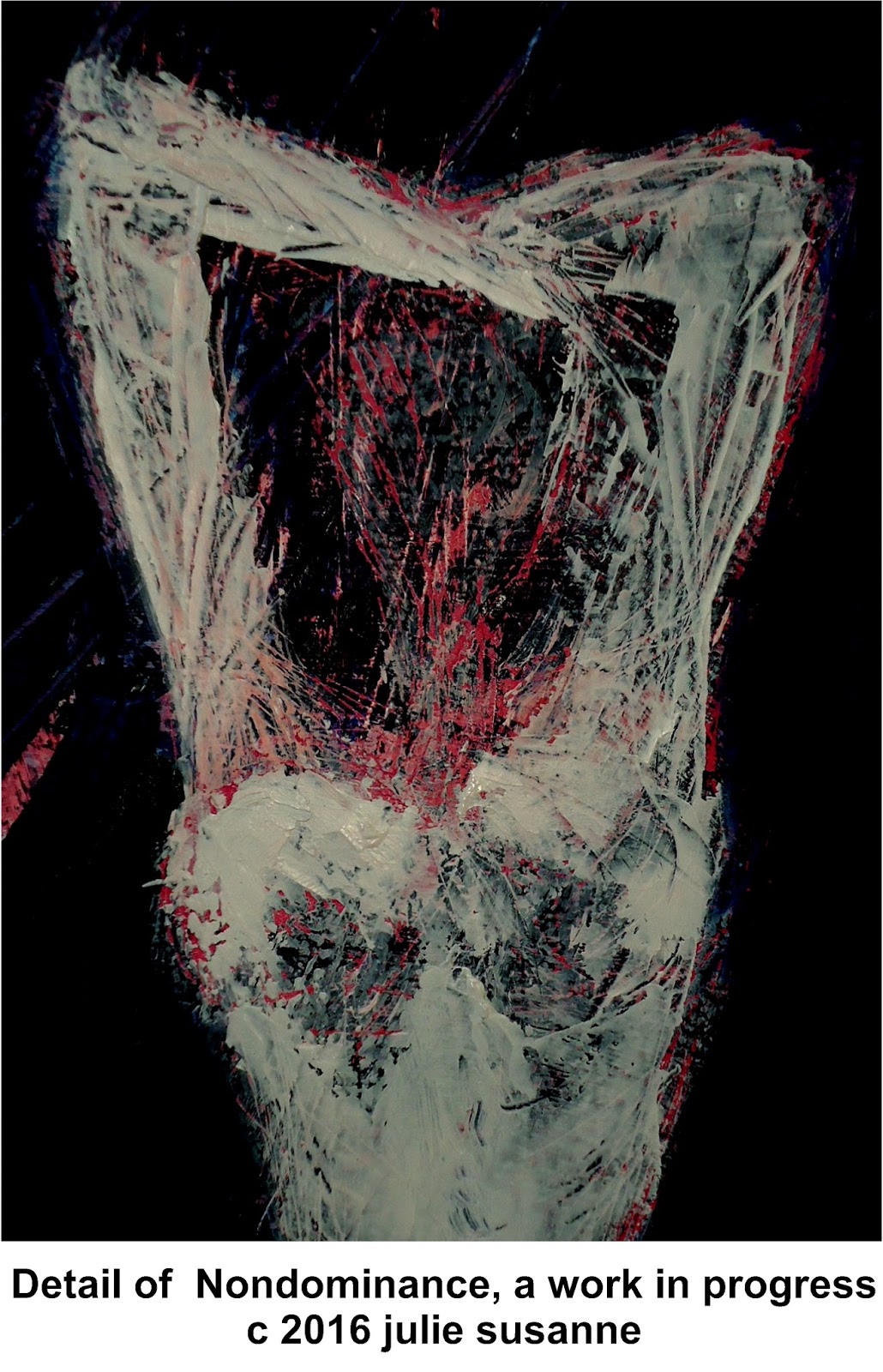
In this series I was looking to do something different; I wanted to go back to painting with oil bar.
I started by attaching paper to a hard surface and painting the paper with gesso and pink acrylic.  I then covered it with another layer of clear acrylic medium. 
 
 
As I was doing this prep work I was contemplating life and the idea of doing things the same way again and again with no better results.  At that point I chose to paint the series with my non-dominant hand, something I had never done in the past.
 
I began each session by practicing moving my energy out of my head and into my heart.  You can learn more about that meditation practice here: Rohini Ralby's Practice For Us. The overall design and subject emerged from this practice.  
 
The entire painting is done with oil stick, oil bar, painting knives, putty knives, razor blades and occasionally a brush.  The diagonal line was created by snapping a string covered in oil paint.  There is layer upon layer paint applied over 5 weeks.  Texture was created by applying oil paint and scratching and scraping the surface when wet as well as when dry.
 

Oil Bar Painting Steps

Below is the progression of painting from start to finish:
Click on any picture to see a close-up


Some detail photos:


This is the first in the series Nondominance,  To see works from previous series, On marriage, click here.


Saturday, March 19, 2016

How to Paint 3: No Judgment

Paint Without Judgment


It is my job to live the life I was meant to live and to learn from my experiences.  For me that means expressing myself and my tools are paint and paintbrushes. I also believe that I have to paint in the face of all the "reasons" that I concoct to not paint: I don't have a good idea, I don't have the time, I don't have enough talent, the end result won't be any good.  I believe I have to paint what I am capable of painting today and to tell the story I am capable of telling today from my own unique perspective.  I communicate with paint and it is not by job to decide (judge) whether a painting is good or bad.  It is my job to paint until it is finished and then start another one.


Saturday, January 16, 2016

How to Paint 2: The Art of Staring


Why a whole post on staring?  Well, because staring is underrated.  I used to think I was a weirdo with the amount of time I spent seemingly doing nothing but staring.  Having been taught to work hard, staring made me feel like a wastrel.  I would sit hours and stare and stare and stare.    Sometimes a blank canvas would await me, sometimes not. 


Imagine my surprise when I read these words:

  • "But as for the rest of my time, the activity I'm most likely to be engaged in is staring.  If staring were an Olympic event I'll be bringing home the gold.  While other people go to work, I stare out the window.  I stare at my dog.  I stare at the blank pieces of paper and paragraphs and single sentences and a buzzing computer screen.  Hours of my day are spent with my eyes glazed over, thinking, waiting, trying to figure things out.  The muse is a sweet idea, like the tooth fairy.  The muse supposedly comes down like lightning and fills your fingers with the necessary voltage to type something up brilliant.  But nobody ever made a living depending on a muse.  The rest of us have to go out and find our inspiration, write and rewrite, stare and stare and stare until we know which way to turn." Ann Patchett from What now?

Validation from a kindred spirit in the act of staring; for it is an act- an active pursuit.  Now there is all kinds of staring.  The purposeful staring I am talking about is goes beyond non-purposeful, diffuse staring with a flurry of random thoughts and ideas and memories and hurts and joys and wants and regrets and to-do lists and, and, and.....

Purposeful staring is more disciplined and more one-pointed...a concentration...a waiting.   A good illustration of disciplined concentration:  Balance Goddess, Lara Jacobs at a TED talk (click here trouble viewing video below) from  TEDx


There is a quietness of the mind (I talk about this here).   This takes practice like anything else; it takes disciplined concentration and control.  Purposeful staring takes this same disciplined concentration. 
 
The Art of Staring is critical to the act of creating.  It is allows the space for the work to present itself.  It allows us to wait and perceive what comes next.   

Saturday, December 19, 2015

This is the Story of a Happy Marriage

Writer, Ann Patchett's, collection of essays gives insight into her creative process of writing both fiction and non-fiction.  Although specifically about her experience with writing, This is the Story of a Happy Marriage speaks to me as a painter.  Today I was specifically struck by a passage in the essay, The Getaway Car, a Practical Memoir about Writing and Life.  She states, "Why is it that we understand playing the cello will require work, but we attribute writing to the magic of inspiration?" 

And, "If you want to write, practice writing.  Practice for hours a day, not to come up with a story you can publish, but because you long to learn how to write well, because there is something that you alone can say."   Patchett elaborates, "Most of us are full up with bad stories, boring stories, self-indulgent stories, searing works of unendurable melodrama.  We must get all of them out of our system in order to find the good stories that may or may not exist in the freshwater underneath."  Now she of course has a whole lot of compelling metaphors in between those statements above, and they illustrate her point well: That becoming good or great at anything requires learning the craft and practicing the craft. 

I believe Patchett is spot on.  Why do I trust Ann Patchett?  She does not give advice for the sake of the advising, she writes about the process as she has lived it.  And her words speak to what I know in my heart to be true about finding the good paintings that exist under the cruddy ones.  I believe most of us have some terrible paintings that we have to get out of our system---by painting them.

Patchett's collection of essays are witty, fresh and insightful.  Her writing connects the reader with the human part of him/herself by exploring her own humanness.  She reminds us of things we have suspected or known about ourselves as well as gives us a new perspective by tossing us morsels of wisdom.  And she does it all without pretension or elitism.

This is the Story of a Happy Marriage is for anyone questioning the way forward or seeking to learn more about themselves through their experiences.  It is especially beneficial to those of us who have creativity as a central theme in our lives. Loved it!


Thursday, January 1, 2015

How To Paint

Learn To Paint 

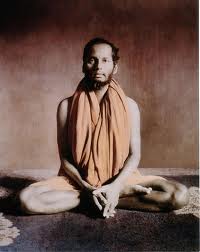
Baba
Swami Muktananda

The mecahanics of painting can be learned from classes, books and master artists.  This is information.  Incorporation of this information into your painting life leads to knowledge.  Your experience with the act of painting deepens this knowledge.  But how do you get to the place of wisdom and the place of creating really, really great art? 

Painting From Your Core

By "painting from your core"  I mean from the center of your being.  I mean being in the moment.  This is very different than doing.  It requires a spiritual approach in which the attention is inward turned.  The attention is turned inward away from the outer manifestations of the mind thoughts.  I believe this requires a specialized teacher.

Painting Using Your Inner Light

It is often said that when you are painting, you are "painting the light."  I want to suggest you take it further and use inner light to paint.  Again this requires a spiritual approach it is an internal process of painting from your Heart. 

This also requires a teacher as few of us were born knowing how to do this.  My teacher is Rohini Ralby.  Her new book Walking Home with Baba: The Heart of Spiritual Practice can help guide you to that wisdom.  She talks about why we need a teacher on her blog.  She addresses finding a teacher with an authentic spiritual lineage.

Painting can be cutting, pasting, repackaging and selling.  Alternatively, you can paint as a spiritual practice and truly unleash your creativity.

Sunday, July 6, 2014

How To Know If You Are A Professional Painter

wave #2
2-3/4" x 6 " x 1/4"
oil on palm sheath and masonite
© 2014 by julie susanne
"Am I a professional painter?" Have you ever asked yourself that question?  How do you know you are a professional painter?  Are you a professional painter because you have a degree in fine arts, because you were in this show or that show?   Or are you a painter because of your commitment and drive?  Do you paint when it is inconvenient? It's too damn hot, you're still painting. It's too cold, you're still painting. Your body hurts from holding the same position, you're still painting. The bugs are tormenting you, you're still painting.  When painting in public, people are critiquing, commenting, quipping, and basically tormenting you as well, you're still painting.  You're tired and hungry, you're still painting.  When you think about painting you are thinking about how to enhance your development, how to push it further how to get better.  Your focus is on making better art.  You rarely think in terms of what is selling right now in order to paint that.  When you do think about painting what is popular, you can't bear the thought of it.  Instead, you paint what you are driven to paint.  You paint because you have to.  When you are not painting, you are unhappy, maybe even depressed.  You wonder how little you could live on to survive and paint full-time.  You sell your stuff to buy more paint or a brush.  You know that if you price your work for what the market will bear that you are making about half of minimum wage, and you paint anyway.  So how do I know I am a professional painter...I just know.

Saturday, March 23, 2013

Selfish Artist?

A question in a recent discussion on Art Biz Blog about whether being an artist is selfish got me thinking. 
Some said yes.  I disagree.
My response below:

"My ego is what tells me I'm being selfish doing my art.

My Divine Self guides me along the right path.

Self-fulfillment is different than ego-fullfillment.

Fulfilling the ego is selfish.

Fulfilling the Self is Self-full. "

Wednesday, December 30, 2009

Lesson of the Century: Am I Being True to My Self? Part 2


Continued from Part 1: Am I Being True to My Self?

All of these qualifiers or adjectives that we use to describe ourselves or allow ourselves to be described by are just ideas. They are extremely relative and can change from moment to moment and person to person. One person may consider my art to be brilliant and another may consider it to be horrid and not to even be considered 'art.' If I can accept that my art is all the adjectives imaginable, both all at once and never, I can be open to any reaction. In this way I could find benefit in considering a point of view different than my own. If, on the other hand, I am attached to the idea that all my art is great, I will not be able to learn and grow from the work that is not-so-great. A valid criticism that could help me would undoubtedly go unheeded.

Through my practice of detaching from ‘being’ a painter and all of the judgments about the work, I actually become freer. If I am less caught up in what others might think, it is more likely I will take more risks in the work and discover more than I ever imagined possible. Both in my art and in myself. In this example, being true to myself is painting authentically. For me that means I might not ever paint a vase of flowers. I love flowers. They are exquisitely beautiful, but I just don’t see myself painting them. 

If the person who created this, um, outdoor installation (see photos) was self- conscious about this piece, they may not have created it and I would not have smiled as I passed by today.  Some may call it art, others may call it hideous,
I just kinda like it...

Please post your thoughts by clicking 'comments' below.

Tuesday, December 29, 2009

Lesson of the Century


As I learn and grow, I realize there is yet more to grow and learn.  Certain life lessons re-emerge and come around again and again until they are finally transcended. I have many, but one that is under all of them is, "Am I being true to my Self?"   For me it truly is the lesson of the century.  One thing I am learning is that being true to ones Self is not selfish it is Self-full.  It is moving beyond the limitations that the mind, the ego, or the small self puts on us and discovering our true nature or true Self.


After a lesson with my spiritual teacher  I wrote this question on my hand with indelible ink as a friendly reminder.   In this way I can remember and remember and remember.  The art in the photo is detail from a large work in progress which has the general theme of letting go of things that no longer serve us.   These 'things" are in many forms:  such as physical stuff,  ideas,  emotions,  personality,  roles,  habits....   It seems that the problem is not really with these things,  it is with our relationship to them.  For example, when we actually believe we are our personality traits,  we can be devastated when something comes up in our lives that questions that view!  Therefore letting go is recognizing that all these things are tools that are appropriate some of the time but not all of the time.  This letting go is what some call being detached or non-attached.

In my personal story, if I believe the sentence "I am a good painter," then I am attached and this does not serve me well.  There is no room for anything else.  The minute someone criticizes my work, I will be crushed.  I may question my choice to paint and may even fall prey to artist's block or some other destructive activity.  If I practice detaching and recognizing that painting is something I do this is a start.  Then I can look at the judgments or qualifiers like 'great,' good,' 'mediocre,'  'lousy,'  and  'horrid.'

 To be continued in part 2 on Thursday...

Please post your contributions by clicking 'comments.'

Thursday, December 17, 2009

Let Creativity Flourish- Organize Your "Stuff"


Yesterday I saw a license plate that simply said, "UNLEASH."  If I want to unleash my creativity and have it  flourish as an artist, I have got to give it the room.  Lives can be very, very cluttered with all sorts of things that do not serve us.  If you simply keep what enhances your life right now, you could free up a lot of physical and emotional clutter.  Some quick tips can be found here: Zen Mind: How To Declutter.

As creative people, we often keep things around that we "might use" in a project.  This is great if these things are stored in a way that does not hinder our work in the meantime.  Otherwise this is just another barrier to being successful.  There are plenty of obstacles beyond our immediate control- we don't need to add to them by creating more barriers!  In a blog post I recently read, the guest author was talking about how to have less stuff by wanting less stuff.  He wasn't just saying "get rid of your stuff."  He was supplying an additional tool to facilitate the change.  Here is the link: How To Want Very Little

Perhaps you have determined that you really do need to keep most of your stuff, but it could be stored in a more manageable way.  For a more in depth and systematic way to organize, Organizing From the Inside Out by Julie Morgenstern is one of the very best books on organizing.  I'll write some more specifics about the book in a later post.

Please contribute your thoughts and suggestions by clicking 'comments.'

Sunday, December 6, 2009

Who You Really Are and Expanding Creativity


One of the things that can keep us each miserable the mind and the thoughts that it decides to think.  We can just continue to allow the mind free rein or we can choose make a shift.  So let's continue with clearing out the mind clutter and allowing creativity the room to grow.  Earlier we explored ways to quiet the mind: Unleashing Creativity.   Taking it further, if we let our minds tell us who we are, that can be very limiting.  In Reality, who we are is limitless!  Once this is truly realized creativity knows no limits.  I discovered another blogger who exquisitely expands on this topic.  I'm keeping it short so you can read her most excellent post here:  Who Are You?.   Thank-you, Alethia Hallador, for a great post!

Post your thoughts by clicking 'comments' below.

Wednesday, November 18, 2009

Not Enough Hours in the Day- Part 3


Earlier this week I began the topic, Not Enough Hours In The Day.  While learning the business side of being an artist, I then ran across a timely post on an art marketing site this week. It directly relates to our discussion about doing too much. In an art business coach's, words, "The problem with saying Yes to everything (which essentially means being a people pleaser) is that you end up saying No to yourself and everything you want for your life."* True to form, art biz coach, Alyson Stanfield, fills in the gaps left by others. Not being able to improve on her words, I encourage you to read Stanfield's full post. Although geared to artists, her suggestions can be easily modified by anyone with the "Yes, I'll do that- disease." To view Stanfield's post, click: Say No With Grace.  I'm keeping it short today- more on this topic in the coming weeks.

* Stanfield, Alyson, Say No With Grace, ArtBizBlog.com, June 23, 2008.


Please post any feedback or remarks by clicking 'comments' below.

Monday, November 16, 2009

Not Enough Hours In The Day- Part 2

This is part two from yesterday's post.  We were talking about recognizing where we are before we can consider an effective change when we are trying to do too much.

OK, I am going to use a simple, silly, personal example to illustrate this.  Most, if not all, of you are not aware that I am an imperfect speller.  If I did not recognize this and/or did not want to make a shift, my writings would be full of misspelled words.  I would not use spell-check and I would not use a dictionary when writing for you.  Furthermore, I would not even pay attention to the words I misspell repeatedly, to try and remember the spelling next time.  Does this make sense?  I accept that my spelling ability is weak and I choose to make a shift.  In my example, the shift is then made by using additional tools as well as my mental memory to learn from my mistakes.

Getting back to shifting to, enough hours.  Let me give you one cool tool I employed many years ago: (repeat after me), "I'll think about it."  It is that simple.  This is the problem I had in doing too much: If someone asked me if I would do something, I barely considered it and said, "yes," as it seemed like a small request and I wanted to be helpful.  At the time, I was a single parent who was working and going to school.  I had also decided I was 'supposed to' volunteer in the children's schools.  Oh, I also had my art studio which I was working in part time.  It was insanity, at best.  To use this tool properly, I had to employ it in all situations: "Julie can you work an extra shift this weekend?" or "Mom, can we stop at the video store, tonight" or "Julie, can you bake some cupcakes for next week's party?"  "Julie can you watch my dog this week?"  Even if I thought I already knew the answer, I would say, "I'll think about it," and give the asker a time that I would get back to them with my answer.  Then I would be able to take a moment to realistically see if this was something I ought to do.  This kept me from either always saying, "yes" or swinging the other way and always saying, "no."  Sometimes "yes' is appropriate and sometimes "no' is appropriate.  If we let the mind give the knee-jerk answer, the response will almost always be the wrong one.  That's another way the mind messes with us, by the way.

Part 3 of this topic shows one way to say "no" with style: Not Enough Hours, Part 3

Please click 'comments' below to post your thoughts.

Sunday, November 15, 2009

Not Enough Hours In The Day- Part 1


When discussing routines, clearing out the mind clutter was one idea presented.  One way was to make a list of tasks.  Another was to write and practice a formal, but flexible routine.  For previous posts click: Routines.  If we write down all that has to be fit in our routine, at some point we may suspect or even determine that "there might not be enough hours in the day." 

Well, guess what.  There aren't.  Not for what my mind has me thinking that I have to do.  What do I mean by this?   Recall that I spoke about how our minds can "run us" rather than we running our minds?  This is just one of the ways a mind can run a person.  By ensuring that every minute of every hour is filled with stuff that "must" be done, it keeps the person running.  Layered on top of this for some is the 'failure factor.'  Because we don't get it all done, some of us can feel like failures, as if we should be able to do a better job.  Why does this even matter?  Because it is another way the mind keeps me from my higher purpose.  For an artist it is one sure way to allow a stifling of creativity.

Perfect Mind Play:  Create a situation that is impossible, then when unsuccessful in completing the super-human task, wallow in a failure stew.  Get up the next day, and do it again.  Are we having fun yet?  Do we just keep doing this day after day and year after year?  News Flash:  It does not have to be this way.

If it had to be this way, it would be a universal truth for all humans.  And I am sure, it is not.  Having experienced both sides of this, I prefer the enough-hours-in-a-day approach.  So, how does one shift from the not enough to the enough?  The first step is, yes, you guessed, recognizing where you are and wanting to make a shift.  This is extremely important.  If  I can not see where I truly am, I just continue to delude myself into thinking I am somewhere else. 

This introduction to 'Not Enough Hours in the Day' has been changed from its original format and divided into parts 1 and 2.
For part 2 click: Not Enough Hours, Part 2


What has worked for you when there was too much to do for the allotted time-frame?
Please post any comments or questions by clicking 'comments' below.

Saturday, October 17, 2009

Unleashing Creativity


When our lives are filled with everyone and everything clamoring for our attention, it can be a challenge to find a way to quiet the distractions that keep us from our creativity. Sometimes the din seems out of our control, other times we may keep it all going simply out of habit. Often it is going on in our own heads. This is not necessarily the optimum mental environment in which to foster creativity.

What if there was a way to have quiet without changing anything going on around you? If you have ever had the experience of 'daydreaming' and being oblivious to what was occurring around you, you have had a glimpse of the idea behind being quiet in the midst of outside distraction. In that case, the daydreaming was, most likely, unconscious and 'just happened.' Your thoughts probably flitted from one thing to another in an undisciplined way. In a more disciplined situation, you may have had the experience of reading a book and not being aware of someone talking to you. In that case, you were willing your mind to concentrate on the reading. Other situations that required extreme concentration and hyper focus were times when you decided what your mind was going to think.

What the above suggests is that your mind does not have to run you. You can learn to discipline and control your mind. And to take it a step further, you can learn to quiet your mind. As part of my spiritual practice, my teacher has taught me how to meditate. In some spiritual paths this is also known as contemplative prayer. I think of it as listening for answers to that which is prayed about. If my mind is in the way, with all of its shenanigans, this can be difficult at best. A teacher is critical to this process. Through this spiritual practice my art has come into better focus and my creativity has been allowed to flourish. In fact, I am painting again because of this practice. This would not be the case if my mind were running the whole show. And it is a show.


If you are not finding the time to practice your art, look to see if your mind is part of what is hindering you. When we talked about clearing out mind clutter (click here) , we saw that the incessant 'to-do' list with its made up deadlines is just one way the mind runs the show. There are plenty of others. Look to see what your mind thinks about- without judgment- just notice its thoughts. As an analogy: it is as if you are in a quiet room and there is the sound of traffic passing on the street outside- each car is a thought passing by. The thought comes, the thought goes. Another one comes, and that one goes. It doesn't affect what is going on in the quiet room. This is one of the first steps to stilling the mind. With the help of an experienced teacher, meditation can eventually lead to stillness despite the external drama. Eventually, one can abide in the stillness while going about her/his day.

The actual act of painting is one way I help still the mind. At the canvas, I am not thinking about tomorrow or what I have to do next in my day. I am simply painting. Right there, right now, that is all that exists. If my mind steps in, I can just say, "shhh, be still," and continue painting.


To unleash creativity means to let it off its leash. Stilling the unsettled mind can lead to freeing creativity. It is a way to give creativity the room that it needs to run. If this idea appeals to you and you want to find a teacher, visualize that the right teacher for you appears. For me, the teacher showed up within 2 weeks of my asking for one. What has occurred since has been the best part of the journey yet, not necessarily the easiest, but the best. I believe that practicing being still is one of the best things I can do for myself as a human being and as a painter.

Have you found another way to unleash your creativity? I'd love to hear about it. Please click 'comments' below to post.


Thursday, October 15, 2009

My Painting Process- Current Work


Yesterday I thought it would be fun to post a drawing from my childhood.  This gives rise to the idea of recognizing our own progress.  Often this is difficult to see as we are so close to our own artwork.  But yesterday's "portrait" drawing next to a current work (hopefully) shows some growth in my drawing and painting abilities. 

Although a silly example, I think this idea as an exercise has some merit;  this could be particularly helpful when faced with challenges in a current work, or you are doubting your abilities,  or you are stuck in some way.  If you have works from an earlier period, pull them out and look at them.  You may surprised at the difference.  If you are working in a different genre now, this can still be valid.    Look at the older piece.    Would you do this the same way if you were creating it today?  Are there obvious problems in the work that you did not know to correct at the time.  Recognize how far you have come.    Is there a common theme you hadn't noticed before?  You may end up jarring your creativity as you critique your own pieces.  You never know what new direction may come out of this sort of an activity. 

I recently looked at a painting I had shown in the 90's.  The composition was way off from my perspective today.  Also, I would have adjusted the concept as it does not feel fully developed.  Another piece that I had shown in a charity auction was a "what were you thinking" moment, in that I certainly was not putting out work that truly represented me. 

Below is the rough draft underpainting of the piece I am working on now.  (Double click to enlarge)


Tomorrow I will show you how it has progressed and talk about the process in greater detail.

To respond or add to this post please click 'comments' below.

Wednesday, October 14, 2009

Clearing The Mind Clutter


We have been talking about tools to use to increase creative opportunities.  When developing a routine (discussed here and here ), you may have come to the conclusion that there are a lot of things you are behind on when you made your list.  First determine if that is really true.  It is one thing if there is a deadline that must be met, like delivering work for an exhibit.  But the other things you are behind on- are there actual deadlines, or have you made some arbitrary deadline?  If the arbitrary deadline serves you and your goals- great!  If it only serves to cause anxiety about being behind- not so great. 

Our minds are incredible tools; untrained they are little monsters.  If there is one thing the untrained mind is very good at, it's messing with us if we are not paying attention (which, I think, is pretty much most of the time).  Arbitrary counterproductive deadlines are an example.  Continually running through the 'mental list' of all the stuff we have to catch up on is another great one.  Want to clear it out?  Get out a piece of paper and write down every single task or activity you feel you are behind on, in no particular order.   A number years ago when a friend and I did this for ourselves: there were well over a hundred items!  Very few of them had "real" deadlines.  It was all made up.  You may have more or less.  Once it is all down, initially add to it as new tasks arise.  Each time your mind begins to think about cleaning out the closets or whatever, remind it that it is on the list.  It does not have to think about it anymore.  This takes practice as the mind looks to latch back on.

You can now use your list appropriately.  Prioritize the activities in a way that makes sense.  I highlight the items I want to complete first.  Then take your written routine and fit in an activity from the list.  This may be once a week, once a day, or once a month- depending on your list and other responsibilities.  Practice being ok with it not all being done- the nature of the untrained mind is to ensure it is never all completed.  This is accomplished by adding new things to do.  If you catch your mind continuing to do this, it is ok to say, "no!"  No new things may be added or thought about until this list is completed. You get to choose what to think about.

As a part of my routine, once a week I will do a house fixing task from my list.  I originally began it first thing in the morning on the appointed day,  but I adjusted my routine to complete it mid-day when it is too hot for me to be outside painting.  I spend no more than 1-2 hours on the task and if not completed, it is the one I do the next week. (This keeps me from leaving a trail of half-finished projects- which is another way my mind loves to mess with me).

This was just one example of beginning to discipline the mind.  Do you have ways that you have cleared out the mind clutter that you want to share?  Click 'comments' below to post.

Saturday, October 10, 2009

The Joy of Routines


OK, I hear you, "Routines are boring."  Routines may seem boring, but once they are established, they simply work in the background and serve you.

A routine can help you to operate more efficiently, provide focus, make overwhelming tasks more manageable or even give you permission to carve out some quality studio time or "you time."  Routines are a tool that, when used appropriately, can help you to live the life that you know in your heart of hearts is best for you. 

Having a routine can help free up your mind to think about what is important to you.  If you are always thinking about the hundreds of things that "need" to be done, that is a clue that your mind is running you.  Wouldn't it be a better idea for you to be in charge of what your mind thinks?   I used to think this was impossible, but have learned to use a number of tools that help me to do just that.  Today I just want to focus on the discipline of a routine.

As a simple illustration, I no longer have to think, “Its time to brush my teeth…I have to remember to brush my teeth…If I don’t brush my teeth I might get cavities,” etc.  My mind is not cluttered with it on my incessant “to do list.”  Neither do I think I am boring because I have this as a routine.  I just brush my teeth at certain times of the day.  It is a routine I established a long time ago and it works in the background to keep me from having my teeth drilled and filled.  I’d say that serves me pretty well.

Many an artistic person believes that if they follow a routine, that will quash their creativity.  They see themselves as interesting; spontaneous; free-and-easy, light-and-breezy; creative.  Often times these are code words for unfocused, chaotic, and without direction.


Of course, I can speak about this with authority, as it is one of the things I have allowed to keep me from my art.  I have unwittingly either created or attracted chaos into my life, but saw it as some other code word.  To the right is a picture I made on the first computer I ever owned- It is hanging above my desk as a friendly reminder.  I should probably have it tattooed to the inside of my eyelids, though that might be a bit much.

How could I realistically expect to __________ (fill in the blank) if I think I am being creative, but am really being chaotic; if I think I have “many interests,” but actually have too many pans in the fire- a jack of all trades, but master of none?

With an established routine, my mind is more free to create.  I am now creating my next body of work.  The exercise of establishing a routine may give you just the reality check that motivates you to consider making a change.  It may even lead you to more joy.  See my post, “10 Steps to Establishing a Routine ” tomorrow.   These steps work for me, add or delete steps as needed.

More about routines next week. I'll also give you a sneek peek at the painting I am working on.


Writing about routines brings up this question:
“What if there aren’t enough hours in the day?”  That is a topic for another day.

Your thoughts? Click ‘comments’ below to post.

Link Within

Related Posts with Thumbnails