Monday, September 5, 2022

Why I Paint


The simple answer is “because I have to,” but that doesn't speak to the truth of the matter. This is why I paint:

It was 2008 and I was sitting with Rohini Ralby, my Guru, in her teaching room. I was not happy and physically unwell at the time. During the session she asked me what I would spend my time doing if I could do anything I wanted. I knew she was asking me what would bring me joy. As she and I sat, a short word bubbled up for me. It was like a whisper and my rational mind pushed it down, both not sure I had heard it and because I decided she meant something more practical and related to earning money. I just sat and looked at Rohini as she looked into my heart of hearts. Then she said the word, “art.” The word I had pushed down.

Over the next few weeks she began instructing me how to paint. Of course I had painted before, but not like this; I would stumble across a painting not knowing how to paint or how I got to the finished painting. It was hit or miss. Rohini patiently instructed me every step of the way. I knew I wanted to paint with oils. I remember this first painting. I got a stretcher 
Untitled, oil on canvas, copyright 2009 by julie susanne
That First Painting (Untitled, © 2009)
from Jim Condron, another artist she instructed. I then chose the color palette as Rohini had directed: Use three colors. As she said “use three colors,” I wondered about white and she said, “Yes, you can use white.” Even choosing the colors was at a different level. She said to choose one as a red, one as a blue, and one as a yellow.
She got me to recognize that colors 
have different vibrations by having me approach the process from a deeper level. The palette she guided my to was cobalt violet as the red, cadmium yellow lemon and prussion blue. As I stretched and gessoed the canvas I did as she had said and waited for the marks to arise, from the deepest place I was capable at the time. 

As with other artists I've seen her instruct over the years, Rohini was with me throughout the painting process: critiquing, guiding, and instructing. She insists we create and live from a place deeper than the superficial place I am used to hanging out.
Rohini Ralby

She helps me to learn to live from a place where God dwells and to paint from 
there. Every unsuccessful painting is due to my approaching the work from that superficial level to do it “my way.” Each painting success happened when I got out of my own way, followed the direction of God and Guru and painted from the deepest place I am capable. I owe my painting success and my life to Rohini Ralby and the Grace of God.

Rohini has a new book available with her teachings, poetry, and paintings: Living the Practice: The Way of Love, Volume 1. 


Saturday, March 3, 2018

Rohini Ralby- Foursquares Paintings- Final Week

Rohini Ralby's first solo show, Foursquares, is currently at Stevenson University.  The opening in February was well attended and Rohini was gracious enough to give an impromptu artist's talk when asked.  Not to be missed is this exhibit of her visual depiction of the vibrations underlying four connected words in what she calls a fourchotomy.  I am fortunate to know artist, Rohini Ralby, as she is also my Guru.   The fourchotomy is one of the tools Rohini uses to teach us how to own, master and transcend vibrations that run us, ruin our lives and keep us from Love and actually living. 

At the opening we were surrounded by amazing art, beautifully rendered, professionally framed and expertly displayed on the four walls around us.  The juiciness of the paint and the richness of the work draws the viewer in.  I could not help but be pulled to one of my "favorites" which has wounded as one of the corners.   

To learn more about fourchotomies in spiritual practice read Rohini's blog post, Artist's Talk.

Rohini's show is up through May 18, 2018.  You can find it at Art Gallery on Stevenson University’s Greenspring Campus, 1525 Greenspring Valley Road, Stevenson, MD 21153. 

The show has been extended through June 22, 2018
Post updated 6/12/18 and 6/18/18 


Sunday, October 8, 2017

Art Opening at Art Gallery of Viera

Brush With Success at Art Gallery of Viera

Opening October 14, 2017 5:30pm


From Cloudscapes Series by julie susanne  

On view at this group show will be the painting Seaside Rain Shower from julie susanne's new Cloudscapes series.


Art Gallery of Viera is pleased to announce its 6th Annual Juried Art Show. ​   Brush with Success 2017 will be on exhibit from October 13th to November 5th.  An opening reception will be held on October 14th from 5:30 pm – 8 pm.  Light refreshments will be provided.  A Presentation of Awards will be made at 7:00 pm,​" from Art Gallery of Viera website.

Art Gallery of Viera
2261 Town Center Avenue
Suite 111
Viera, Florida 32940 
321-504-4343

Hours
Monday - Saturday  10:00AM - 09:00PM 
Sunday  12:00PM - 06:00PM

Come to see the incredible fine art in this group show. 
 

Saturday, April 23, 2016

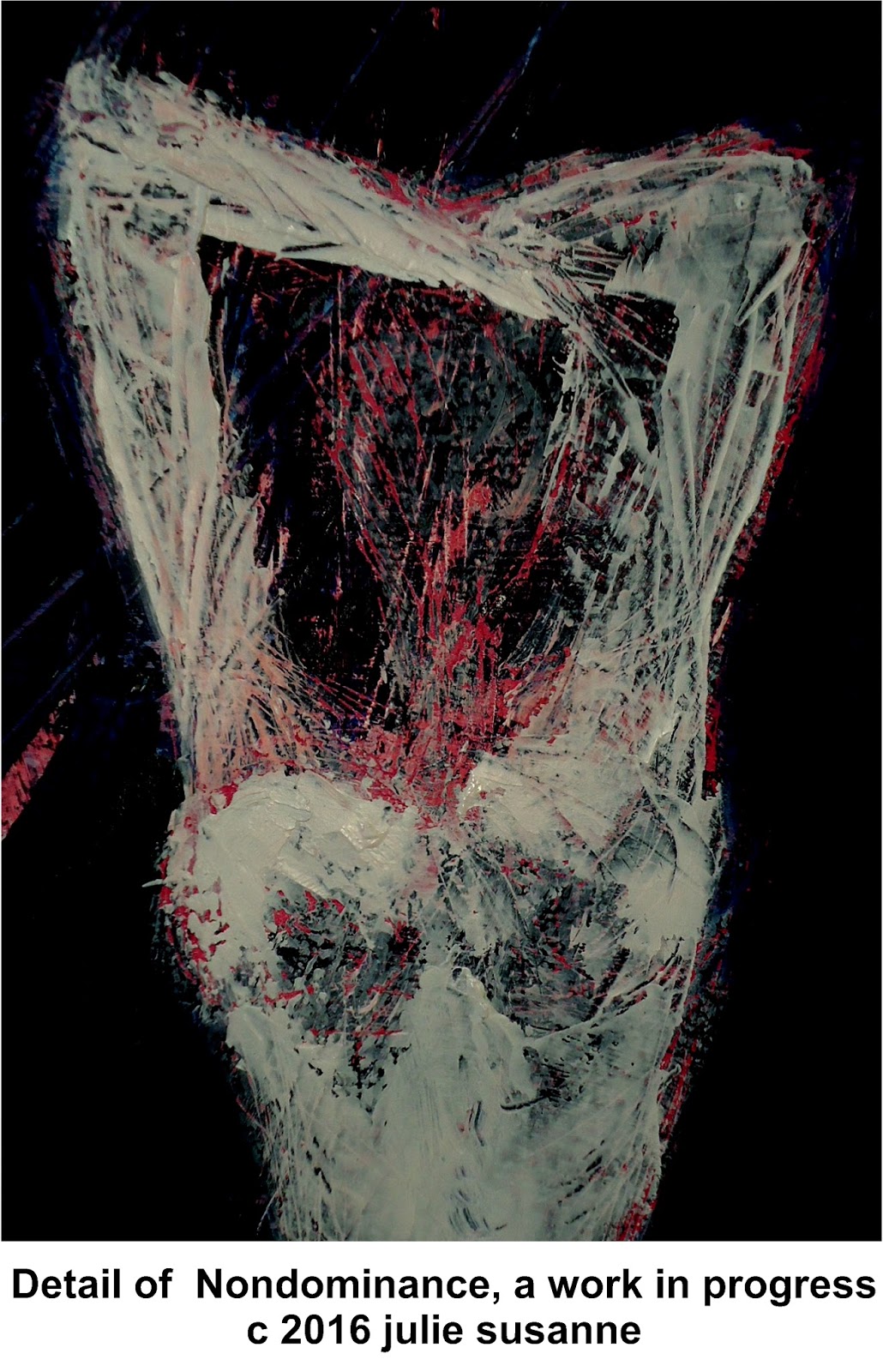
Non Dominance, A New Series

How to Start a New Series of Paintings

In this series I was looking to do something different; I wanted to go back to painting with oil bar.
I started by attaching paper to a hard surface and painting the paper with gesso and pink acrylic.  I then covered it with another layer of clear acrylic medium. 
 
 
As I was doing this prep work I was contemplating life and the idea of doing things the same way again and again with no better results.  At that point I chose to paint the series with my non-dominant hand, something I had never done in the past.
 
I began each session by practicing moving my energy out of my head and into my heart.  You can learn more about that meditation practice here: Rohini Ralby's Practice For Us. The overall design and subject emerged from this practice.  
 
The entire painting is done with oil stick, oil bar, painting knives, putty knives, razor blades and occasionally a brush.  The diagonal line was created by snapping a string covered in oil paint.  There is layer upon layer paint applied over 5 weeks.  Texture was created by applying oil paint and scratching and scraping the surface when wet as well as when dry.
 

Oil Bar Painting Steps

Below is the progression of painting from start to finish:
Click on any picture to see a close-up


Some detail photos:


This is the first in the series Nondominance,  To see works from previous series, On marriage, click here.


Saturday, March 19, 2016

How to Paint 3: No Judgment

Paint Without Judgment


It is my job to live the life I was meant to live and to learn from my experiences.  For me that means expressing myself and my tools are paint and paintbrushes. I also believe that I have to paint in the face of all the "reasons" that I concoct to not paint: I don't have a good idea, I don't have the time, I don't have enough talent, the end result won't be any good.  I believe I have to paint what I am capable of painting today and to tell the story I am capable of telling today from my own unique perspective.  I communicate with paint and it is not by job to decide (judge) whether a painting is good or bad.  It is my job to paint until it is finished and then start another one.


Saturday, January 16, 2016

How to Paint 2: The Art of Staring


Why a whole post on staring?  Well, because staring is underrated.  I used to think I was a weirdo with the amount of time I spent seemingly doing nothing but staring.  Having been taught to work hard, staring made me feel like a wastrel.  I would sit hours and stare and stare and stare.    Sometimes a blank canvas would await me, sometimes not. 


Imagine my surprise when I read these words:

  • "But as for the rest of my time, the activity I'm most likely to be engaged in is staring.  If staring were an Olympic event I'll be bringing home the gold.  While other people go to work, I stare out the window.  I stare at my dog.  I stare at the blank pieces of paper and paragraphs and single sentences and a buzzing computer screen.  Hours of my day are spent with my eyes glazed over, thinking, waiting, trying to figure things out.  The muse is a sweet idea, like the tooth fairy.  The muse supposedly comes down like lightning and fills your fingers with the necessary voltage to type something up brilliant.  But nobody ever made a living depending on a muse.  The rest of us have to go out and find our inspiration, write and rewrite, stare and stare and stare until we know which way to turn." Ann Patchett from What now?

Validation from a kindred spirit in the act of staring; for it is an act- an active pursuit.  Now there is all kinds of staring.  The purposeful staring I am talking about is goes beyond non-purposeful, diffuse staring with a flurry of random thoughts and ideas and memories and hurts and joys and wants and regrets and to-do lists and, and, and.....

Purposeful staring is more disciplined and more one-pointed...a concentration...a waiting.   A good illustration of disciplined concentration:  Balance Goddess, Lara Jacobs at a TED talk (click here trouble viewing video below) from  TEDx


There is a quietness of the mind (I talk about this here).   This takes practice like anything else; it takes disciplined concentration and control.  Purposeful staring takes this same disciplined concentration. 
 
The Art of Staring is critical to the act of creating.  It is allows the space for the work to present itself.  It allows us to wait and perceive what comes next.   

Saturday, December 19, 2015

This is the Story of a Happy Marriage

Writer, Ann Patchett's, collection of essays gives insight into her creative process of writing both fiction and non-fiction.  Although specifically about her experience with writing, This is the Story of a Happy Marriage speaks to me as a painter.  Today I was specifically struck by a passage in the essay, The Getaway Car, a Practical Memoir about Writing and Life.  She states, "Why is it that we understand playing the cello will require work, but we attribute writing to the magic of inspiration?" 

And, "If you want to write, practice writing.  Practice for hours a day, not to come up with a story you can publish, but because you long to learn how to write well, because there is something that you alone can say."   Patchett elaborates, "Most of us are full up with bad stories, boring stories, self-indulgent stories, searing works of unendurable melodrama.  We must get all of them out of our system in order to find the good stories that may or may not exist in the freshwater underneath."  Now she of course has a whole lot of compelling metaphors in between those statements above, and they illustrate her point well: That becoming good or great at anything requires learning the craft and practicing the craft. 

I believe Patchett is spot on.  Why do I trust Ann Patchett?  She does not give advice for the sake of the advising, she writes about the process as she has lived it.  And her words speak to what I know in my heart to be true about finding the good paintings that exist under the cruddy ones.  I believe most of us have some terrible paintings that we have to get out of our system---by painting them.

Patchett's collection of essays are witty, fresh and insightful.  Her writing connects the reader with the human part of him/herself by exploring her own humanness.  She reminds us of things we have suspected or known about ourselves as well as gives us a new perspective by tossing us morsels of wisdom.  And she does it all without pretension or elitism.

This is the Story of a Happy Marriage is for anyone questioning the way forward or seeking to learn more about themselves through their experiences.  It is especially beneficial to those of us who have creativity as a central theme in our lives. Loved it!


Sunday, September 27, 2015

Oil Painting Mediums: Safflower Oil

Paint can yellow over time.  This is more of a concern lighter colored pigments.  As linseed oil has a tendency to yellow as it dries, artists and paint makers have found alternative oils for oil painters.  One of the most popular is Safflower Oil. 

Safflower oil is considered a reliable, pale drying oil.  Because it has good color retention and is believed to not yellow over time some prefer its use when making whites or light colored paints.  It is said to give oil paints a satin finish and buttery feel.

Oil Paints Made with Safflower Oil

  • Blick oil paints from Dick Blick are primarily made with first-press, non-yellowing safflower oil (there are 4 exceptions). High Quality Artist Grade Paint and a Good Value.
  • Sennelier are made with first-press, non-yellowing safflower oil. High Quality Artist Grade Paint.
  • RGH Paints have Cremnitz white made with your choice of 4 different oils: RGH Cremnitz White.  They also make pure Titanium and will custom mix with the oil of your choice.  High Quality Hand Made Artist Grade Paint and a Good Value.
  • Winsor and Newton (W&N) have some lighter colors made with safflower oil.  For example Titanium white and Zinc white.  But be careful if you want pure titanium white, W&N's is not pure.  (I talk about that here:  Paint Ingredients: Which White is in the Tube?    Read about the paint labeling inconsistencies: Oil Paint Ingredients.  Read more about choosing white paint: White Paint Ingredients: Lead, Zinc, Titanium).
Not all share the opinion that light colors are best mixed with Safflower Oil: Regarding Safflower Oil and Poppyseed Oil, R&F, the maker of pigment sticks, website states: "But those oils are very slow drying and prone to cracking, whereas linseed oil dries to a tougher, more flexible film."

Artist Jonathan Linton in his 5 year study,  has made some interesting observations about yellowing here: White Test.

Why Oil Paint Yellows is addressed in next month's post.

Artist Grade Safflower Oil vs Food Grade Safflower Oil

You may ask, "Can I use safflower oil from the grocery store?"   This is not the best choice due to the way in which it is produced.   First, there is a question of kitchen oils' purity; there may be additives, such as vitamin e which can hinder or prevent drying.  I recently read a journal article that points to contaminants as the the primary culprit in yellowing (2).  In addition, there is apparantly a wide range of drying ability in safflower oil.  Food grade safflower oil may have an an iodine value (correlates with oil's ability to dry) of as low as 87, where 130 or greater is preferred (1).


1. Knowles, P.F., Variability in oleic and linoleic acid contents of safflower oil, Economic Botany, , Volume 19, Issue 1, pp 53-62

2. Mallégol, Jacky; Lemaire, Jacques; Gardette, Jean-Luc, Yellowing of oil-based paints,
Studies in Conservation Vol. 46, No. 2 (2001), pp. 121-131


Monday, August 3, 2015

Art Nerd; Check Out This Great Art Website

Featured Art Website: Art-Nerd.com


Got Art? This website sports what's hot in 5 cities! 
Art Nerd  City Guides: New York · Chicago · Los Angeles · San Francisco · Seattle 
Art-Nerd.com/newyork/
Founded by Lori Zimmer, Art Nerd New York has piles of eye candy for artists and art lovers.  
Why (one of my) favorite Art Nerd features is ON THE INSIDE TIP: Studio Visits;  I love seeing what other working artists are doing now!
And check out Lori's new book The Art of Cardboard: Big Ideas for Creativity, Collaboration, Storytelling and Reuse .  It's 160 pages of cardboard heaven and looks totally irresistible (I couldn't).  And if you hurry, you may still be able to get a signed copy!!    

Sunday, June 7, 2015

Wedding Party

Wedding Party Painting

Wedding Party was completed after many layers of oil paint using glaze technique.  From the series about marriage.  Below is of unframed diptych.

Wedding Party, 12" x 24" x 1/4", oil on masonite, © 2013 julie susanne

Sunday, May 10, 2015

Oil Painting Mediums; Linseed Oils part 2

Why Use Oil as an Oil Painting Medium

Oil paints in their purest form are made with ground pigment and oil.  Therefore oil is a superb and highly compatible medium.though oil paint can be used directly out of the tube as is (and this is a fine way to paint), there are numerous oil mediums that oil painters can use.  This post discusses the difference between the various types of linseed oil.

What is the Difference Between Types of Linseed Oil

Through their manufacturing methods, the properties of linseed oils can be manipulated : Thickness, Color, Drying Time, Handling and Paint Film Strength.  Choosing a form of linseed oil depends on the desired use.

Linseed Oil

Linseed Oil is produced from the seed of the flax plant.  It dries slowly by oxidation and remains workable or "open" for a long time.  This can be very beneficial to the oil painter.  Once it is dry it can not be reversed.  Linseed oil is an excellent paint binder and medium, and excellent drier forming a strong paint film.  Straight linseed oil as your medium is a time honored choice.  Use less oil in layers closest to canvas and use more oil in the top layers.

Cold-Pressed Linseed Oil

Cold-pressed linseed oil is linseed oil in it's purest state.  Raw flax seeds or linseeds are crushed without the use of heat.  Because this is a low yield process, Cold-pressed linseed oil is a more expensive form of linseed oil.  Although there is some debate, paints made with cold pressed linseed oil are thought to have superior film strength, handling and brilliance to paints made with refined oils.

Alkali Refined Linseed Oil

Flax seeds are processed with use of heat via steam.  The heated seed are pressed and linseed and waste products are produced.  These waste products called mucilage or foots are removed through a refining process.  Sulfuric acid is used to treat the steam-treated, pressed linseed oil which destroys the waste products.  The acid is then neutralized with an alkali.  This alkali-refined linseed oil is a neutral, acid free oil and is is an inexpensive alternative to cold pressed linseed oil.  Less expensive high quality paints with high pigment content can be made with alkali-refined linseed oil.

Refined Linseed Oil

This is the same as alkali refined linseed oil.

Steam Pressed Linseed Oil

This is also the same as alkali refined linseed oil.

Sun-Thickened Linseed Oil

Sun-thickened linseed oil is the choice for using linseed oil as a painting medium during the painting process.  Sun-thickened linseed oil is made by mixing equal amounts of linseed oil and water and then left exposed to sunlight for several weeks.  Exposure to the sun lightens the oil by bleaching and partially oxidizes the oil.  Better results are obtained using this thicker bodied form;  It is a superb viscous medium that leaves texture and brushstrokes on the canvas and because it is partially oxidized and is therefore a faster drier than either cold-pressed or alkali refined linseed oil.  The lighter color and partial oxidation is also thought to reduce the yellowing of paint later compared to cold-pressed linseed oil and alkali-refined linseed oil.

Stand Oil

Similar to sun-thickened linseed oil, stand oil uses heat to create a bodied medium.  Linseed oil is heated at 550° F for at least 12 hours in an airtight oxygen-free container.  This causes the stand oil to polymerize rather than oxidize due to the absence of oxygen.  The result is a viscous medium that does not leave texture or brushstrokes and is superb for used when glazing.  It has a very strong paint film that resists cracking when dry.  I love to use stand oil in my glazing recipe that is damar varnish, stand oil, and mineral spirits.

Superb Oil Paint Medium Technique Using Linseed Oil

  1. With paint thinned with mineral spirits (or turpentine) paint first layer onto gessoed canvas or panel and let dry if desired.
  2. With paint straight from tube or lightly thinned with stand oil or sun-thickened linseed oil, paint next layers and let dry if desired.
  3. With paint thinned only with stand oil or sun-thickened linseed oil, paint final layers.
The above method generally not only maintains a "Fat over Lean" concept but also allows a full bodied layered painting technique improving depth and textural brilliance.  This method dries faster than using regular linseed oils, but still dries slowly.

Saturday, March 7, 2015

Best Oil Paint Glaze for a Smooth Surface

Oil Painting Glaze Ingredients
Damar Varnish: Linseed Stand Oil: Mineral Spirits
My favorite glaze for oil painting is Damar Varnish: Linseed Stand Oil: Mineral Spirits* in a  1:1:1 ratio. This is a very high quality clear glaze that creates a strong paint film.  This homemade glaze is mixed in a very small quantity:  I put equal parts in a 1 oz glass jar with a screw top lid and shake it up.  I usually make a small amount at a time, because it does thicken up a bit over time.  I do not dip into the jar, but pour it out into my paint mixing container.   Treated this way, it will last weeks in a tightly lidded jar.

This glaze mixture is said to dry relatively quickly. I find that it takes several days in my humid climate. Even though reworking the painting can occur early in initial painting session of a new glaze layer, the painting does not remain 'open' beyond this first day as this glaze becomes increasingly tacky during the drying period. That being said, there is a much longer open period compared to Liquin glaze.

This is perfect glaze for using on panels or other smooth rigid supports.  I also like to use it on canvas.  I use this formula of glaze when I want an extremely smooth surface without much in the way of texture or brushstrokes.
 
Many of my paintings are layer upon layer upon layer....of glazes and transparent or semi-transparent paints.  This glaze is perfect for this style of multi-layered painting.  The end result is a finish that has a slight sheen, but not a high gloss finish.
 
*The Brands I use: Richeson Damar Varnish, Maimeri Stand  Linseed Oil, Gamblin Gamsol 100% Odorless Mineral Spirits.


Saturday, February 14, 2015

Going to the Chapel

Going to the Chapel- A Painting

Going to the Chapel from the series about marriage.
In the final stage foggy mist was added.  See the pre-mist version here.


Going to the Chapel


10" x 30" x 1"
oil on canvas
© 2013 by julie susanne


Detail of Going to the Chapel.

Bride with bouquet.


Again, the albatross.


Skull and stone pathway.


Chapel and hooded figures.

Thursday, January 1, 2015

How To Paint

Learn To Paint 

Baba
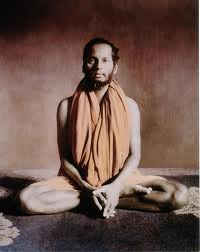
Swami Muktananda

The mecahanics of painting can be learned from classes, books and master artists.  This is information.  Incorporation of this information into your painting life leads to knowledge.  Your experience with the act of painting deepens this knowledge.  But how do you get to the place of wisdom and the place of creating really, really great art? 

Painting From Your Core

By "painting from your core"  I mean from the center of your being.  I mean being in the moment.  This is very different than doing.  It requires a spiritual approach in which the attention is inward turned.  The attention is turned inward away from the outer manifestations of the mind thoughts.  I believe this requires a specialized teacher.

Painting Using Your Inner Light

It is often said that when you are painting, you are "painting the light."  I want to suggest you take it further and use inner light to paint.  Again this requires a spiritual approach it is an internal process of painting from your Heart. 

This also requires a teacher as few of us were born knowing how to do this.  My teacher is Rohini Ralby.  Her new book Walking Home with Baba: The Heart of Spiritual Practice can help guide you to that wisdom.  She talks about why we need a teacher on her blog.  She addresses finding a teacher with an authentic spiritual lineage.

Painting can be cutting, pasting, repackaging and selling.  Alternatively, you can paint as a spiritual practice and truly unleash your creativity.

Sunday, October 12, 2014

Oil Painting Mediums part 1

Oil Painting Mediums part 1

Oil paint can be used directly out of the tube as is.  And this is a fine way to paint.  Paint with the paint; clean the brush. The end.  With this method of using no medium, paying attention to oil content of paint may be important to preventing cracking- use most oil laden paint (which is slower drying) on upper layers: "Fat over Lean."

Linseed Oil

Alternatively use straight linseed oil as your medium, using less oil in layers closest to canvas and use more oil in the top layers...again "Fat over Lean."  More Oil (more fat) = More Drying Time!

Turpentine

Turpentine a solvent can be used to thin paint- it dries quickly and is best used for first layers or blocking in a painting; a very lean layer of oil paint.

I previously used pure gum turpentine for thinning and cleaning brushes.  It had a sweet strong odor.  Now I can no longer find this, either in hardware store or art supply store.  Yes, "pure gum turpentine" can still be purchased, but it is different...way different.  It has a foul, dead animal smell that I find terribly offensive.  I don't use it anymore.

Mineral Spirits

Mineral Spirits is a solvent that can be used in place of turpentine.  As with turpentine, paint thinned with mineral spirits makes for a leaner layer than paint right out of the tube.  I have used Gamsol 100% Pure Odorless Mineral Spirits as well as Kleen Strip Odorless Mineral Spirits from my local hardware store.  I do not notice a difference between these two.  Use mineral spirits for thinning oil colors, modifying other painting mediums, and studio clean up.  Less Oil (less fat or lean) = less drying time.

Simplest Oil Paint Medium Technique

  1. With paint thinned with mineral spirits (or turpentine) paint first layer onto gessoed canvas and let dry if desired.
  2. With paint straight from tube or lightly thinned with oil (such as linseed oil) paint next layers and let dry if desired.
  3. With paint thinned only with oil paint final layers .
The above method generally not only maintains a "Fat over Lean" concept but also allows a layered painting technique improving depth and luminosity. 


Sunday, July 6, 2014

How To Know If You Are A Professional Painter

wave #2
2-3/4" x 6 " x 1/4"
oil on palm sheath and masonite
© 2014 by julie susanne
"Am I a professional painter?" Have you ever asked yourself that question?  How do you know you are a professional painter?  Are you a professional painter because you have a degree in fine arts, because you were in this show or that show?   Or are you a painter because of your commitment and drive?  Do you paint when it is inconvenient? It's too damn hot, you're still painting. It's too cold, you're still painting. Your body hurts from holding the same position, you're still painting. The bugs are tormenting you, you're still painting.  When painting in public, people are critiquing, commenting, quipping, and basically tormenting you as well, you're still painting.  You're tired and hungry, you're still painting.  When you think about painting you are thinking about how to enhance your development, how to push it further how to get better.  Your focus is on making better art.  You rarely think in terms of what is selling right now in order to paint that.  When you do think about painting what is popular, you can't bear the thought of it.  Instead, you paint what you are driven to paint.  You paint because you have to.  When you are not painting, you are unhappy, maybe even depressed.  You wonder how little you could live on to survive and paint full-time.  You sell your stuff to buy more paint or a brush.  You know that if you price your work for what the market will bear that you are making about half of minimum wage, and you paint anyway.  So how do I know I am a professional painter...I just know.

Sunday, March 30, 2014

Art Opening at Expressions

Beach Shack
6" x 12" x 1/4"
oil on masonite
© 2014 by julie susanne
Expressions of Local Art in Melbourne Beach, Florida is the place to be this Wednesday evening for Meet the Artisit Nite. This new venue is having it's second art opening Wednesday, April 2, 2014 from 7pm to 9pm. Stop in and see my latest work from the series: Old Florida.


Saturday, February 22, 2014

Protecting Oil Paintings; Temperature and Humidity

Painted properly, an oil painting's driest layer or leanest layer is underneath the surface layers. These surface layers contain the fattest paint or the paint containing the most oil. A painting can thus dry from the inside-out without cracking. A painting can take a month or more to "dry." Though it may be 6 months or more before a painting has cured or sufficiently hardened. I began discussing caring for an oil painting in a previous post. Environmental factors can aid or inhibit the curing process. Temperature and humidity can negatively impact a painting. The ideal environment is dust-free, smoke free at a temperature of 70° F and a relative humidity of 45-55%. These archivally perfect conditions can be replicated for work that you intend to last centuries. If perfect museum conditions are not possible or practical, a modified plan can be put into place. For example, during the most humid time of the year, keep paintings in a climate controlled environment. Temperature fluctuates less in inner rooms, and on inner walls. Outer walls and rooms closer to the exterior have greater temperature and humidity changes. Prevent mold and moisture and heat exposure by not hanging artwork in bathrooms, kitchens or other moist areas. Limit other environmental insult by not keeping art near fireplaces, wood stoves or in rooms where cooking occurs. Artwork placed on walls near radiators and wall vents can also suffer. Ideally art should not be stored in attics, basements or garages. Even taking a few simple precautions can extend the life of your original artwork.

Wednesday, January 29, 2014

Caring For Oil Paintings

Protecting Artwork; Newly Painted Work
Although paintings are dry at the time of sale, they have often not had enough time to cure. Curing is a chemical process that can take 6 months or longer. During this time it is important to protect the artwork from damage. Do not touch, rub, scrape or clean a painting for at least a year from the date of purchase. Do not seal or varnish a painting during this time either. If moving or shipping a painting It is critical that the painted area does lean against any surface and does not touch packing materials in any way. When viewing artwork before purchase, during purchase or after purchase, do not allow the painting to be touched. Even after the curing process it is important to protect the painting from dirt and oils from hands, or other items.

Tuesday, December 10, 2013

Expressions of Local Art, Melbourne Beach, Florida


Art Meets Local Color

 
Boats and Deep Sky
7 1/4" x 10 1/4" x 1/4"
oil on masonite
© 2014 by julie susanne
Central Florida's newest art venue promises to be "something a little different," according to Billie and Bruce Black, the proprietors; Think: art gallery meets beach casual. Steps from the ocean at Melbourne Beach, Expressions of Local Art has invited local artists to display their beach themed work in this venue on Ocean Avenue. Approximately 20 artists will have original work for sale at various price points. There are paintings, sculpture, furniture, jewelry, garden art and more. The Grand Opening Night where you can Meet and Greet the Artists will be December 19, 2013 from 7pm to 9pm. Stop in and see my latest work from the series: Old Florida!

Link Within

Related Posts with Thumbnails