Saturday, March 19, 2016
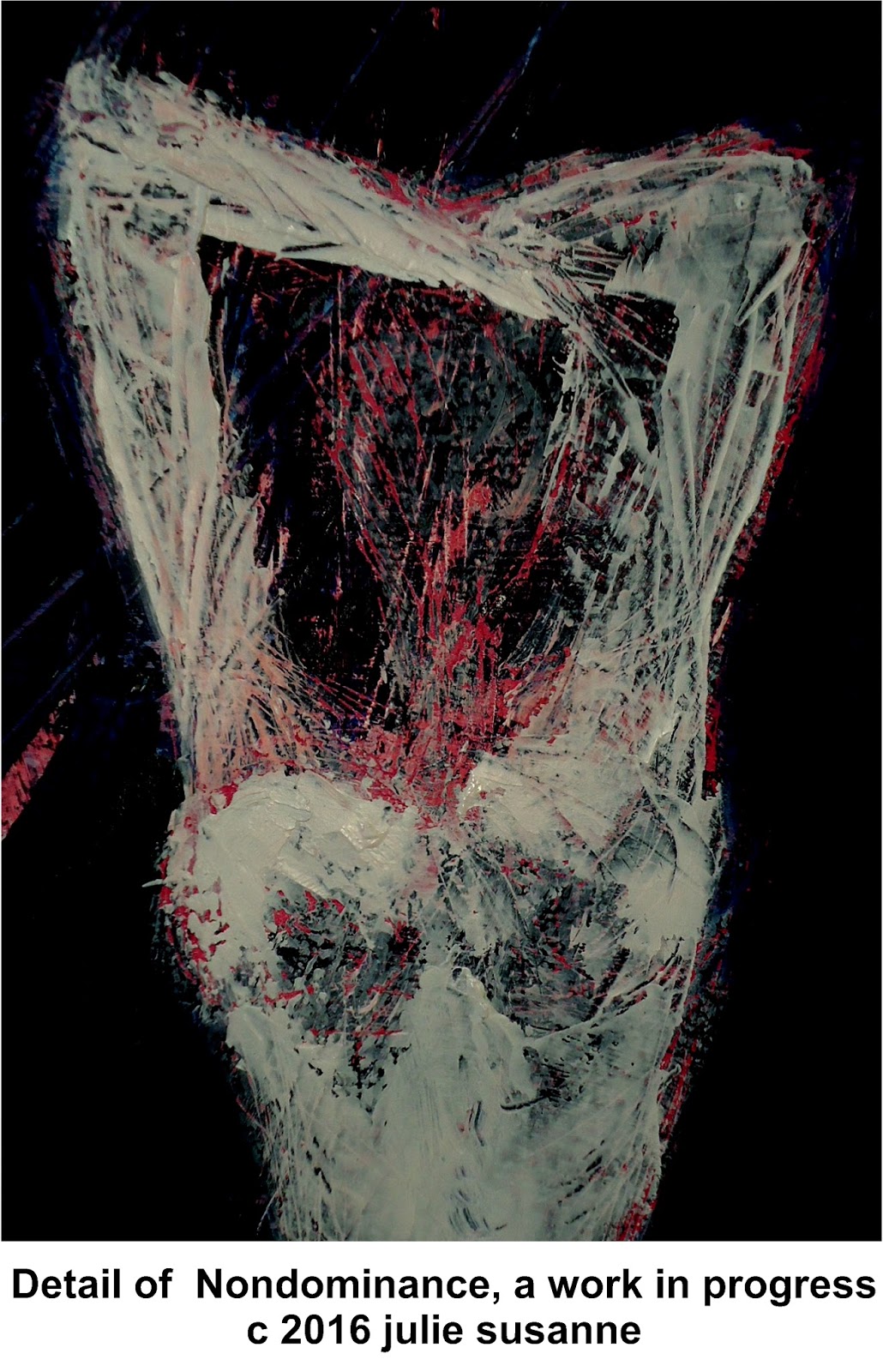
How to Paint 3: No Judgment
Labels:
Increasing Creativity,
Meditation,
Mind,
Spirituality
Saturday, January 16, 2016
How to Paint 2: The Art of Staring
Imagine my surprise when I read these words:
- "But as for the rest of my time, the activity I'm most likely to be engaged in is staring. If staring were an Olympic event I'll be bringing home the gold. While other people go to work, I stare out the window. I stare at my dog. I stare at the blank pieces of paper and paragraphs and single sentences and a buzzing computer screen. Hours of my day are spent with my eyes glazed over, thinking, waiting, trying to figure things out. The muse is a sweet idea, like the tooth fairy. The muse supposedly comes down like lightning and fills your fingers with the necessary voltage to type something up brilliant. But nobody ever made a living depending on a muse. The rest of us have to go out and find our inspiration, write and rewrite, stare and stare and stare until we know which way to turn." Ann Patchett from What now?
Validation from a kindred spirit in the act of staring; for it is an act- an active pursuit. Now there is all kinds of staring. The purposeful staring I am talking about is goes beyond non-purposeful, diffuse staring with a flurry of random thoughts and ideas and memories and hurts and joys and wants and regrets and to-do lists and, and, and.....
Purposeful staring is more disciplined and more one-pointed...a concentration...a waiting. A good illustration of disciplined concentration: Balance Goddess, Lara Jacobs at a TED talk (click here trouble viewing video below) from TEDx
There is a quietness of the mind (I talk about this here). This takes practice like anything else; it takes disciplined concentration and control. Purposeful staring takes this same disciplined concentration.
The Art of Staring is critical to the act of creating. It is allows the space for the work to present itself. It allows us to wait and perceive what comes next.
Saturday, December 19, 2015
This is the Story of a Happy Marriage
Writer, Ann Patchett's, collection of essays gives insight into her creative process of writing both fiction and non-fiction. Although specifically about her experience with writing, This is the Story of a Happy Marriage speaks to me as a painter. Today I was specifically struck by a passage in the essay, The Getaway Car, a Practical Memoir about Writing and Life. She states, "Why is it that we understand playing the cello will require work, but we attribute writing to the magic of inspiration?"
And, "If you want to write, practice writing. Practice for hours a day, not to come up with a story you can publish, but because you long to learn how to write well, because there is something that you alone can say." Patchett elaborates, "Most of us are full up with bad stories, boring stories, self-indulgent stories, searing works of unendurable melodrama. We must get all of them out of our system in order to find the good stories that may or may not exist in the freshwater underneath." Now she of course has a whole lot of compelling metaphors in between those statements above, and they illustrate her point well: That becoming good or great at anything requires learning the craft and practicing the craft.
I believe Patchett is spot on. Why do I trust Ann Patchett? She does not give advice for the sake of the advising, she writes about the process as she has lived it. And her words speak to what I know in my heart to be true about finding the good paintings that exist under the cruddy ones. I believe most of us have some terrible paintings that we have to get out of our system---by painting them.
Patchett's collection of essays are witty, fresh and insightful. Her writing connects the reader with the human part of him/herself by exploring her own humanness. She reminds us of things we have suspected or known about ourselves as well as gives us a new perspective by tossing us morsels of wisdom. And she does it all without pretension or elitism.
This is the Story of a Happy Marriage is for anyone questioning the way forward or seeking to learn more about themselves through their experiences. It is especially beneficial to those of us who have creativity as a central theme in our lives. Loved it!
Sunday, September 27, 2015
Oil Painting Mediums: Safflower Oil
Paint can yellow over time. This is more of a concern lighter colored pigments. As linseed oil has a tendency to yellow as it dries, artists and paint makers have found alternative oils for oil painters. One of the most popular is Safflower Oil.
Safflower oil is considered a reliable, pale drying oil. Because it has good color retention and is believed to not yellow over time some prefer its use when making whites or light colored paints. It is said to give oil paints a satin finish and buttery feel.
Artist Jonathan Linton in his 5 year study, has made some interesting observations about yellowing here: White Test.
Why Oil Paint Yellows is addressed in next month's post.
1. Knowles, P.F., Variability in oleic and linoleic acid contents of safflower oil, Economic Botany, , Volume 19, Issue 1, pp 53-62
2. Mallégol, Jacky; Lemaire, Jacques; Gardette, Jean-Luc, Yellowing of oil-based paints,
Safflower oil is considered a reliable, pale drying oil. Because it has good color retention and is believed to not yellow over time some prefer its use when making whites or light colored paints. It is said to give oil paints a satin finish and buttery feel.
Oil Paints Made with Safflower Oil
- Blick oil paints from Dick Blick are primarily made with first-press, non-yellowing safflower oil (there are 4 exceptions). High Quality Artist Grade Paint and a Good Value.
- Sennelier are made with first-press, non-yellowing safflower oil. High Quality Artist Grade Paint.
- RGH Paints have Cremnitz white made with your choice of 4 different oils: RGH Cremnitz White. They also make pure Titanium and will custom mix with the oil of your choice. High Quality Hand Made Artist Grade Paint and a Good Value.
- Winsor and Newton (W&N) have some lighter colors made with safflower oil. For example Titanium white and Zinc white. But be careful if you want pure titanium white, W&N's is not pure. (I talk about that here: Paint Ingredients: Which White is in the Tube? Read about the paint labeling inconsistencies: Oil Paint Ingredients. Read more about choosing white paint: White Paint Ingredients: Lead, Zinc, Titanium).
Artist Jonathan Linton in his 5 year study, has made some interesting observations about yellowing here: White Test.
Why Oil Paint Yellows is addressed in next month's post.
Artist Grade Safflower Oil vs Food Grade Safflower Oil
You may ask, "Can I use safflower oil from the grocery store?" This is not the best choice due to the way in which it is produced. First, there is a question of kitchen oils' purity; there may be additives, such as vitamin e which can hinder or prevent drying. I recently read a journal article that points to contaminants as the the primary culprit in yellowing (2). In addition, there is apparantly a wide range of drying ability in safflower oil. Food grade safflower oil may have an an iodine value (correlates with oil's ability to dry) of as low as 87, where 130 or greater is preferred (1).1. Knowles, P.F., Variability in oleic and linoleic acid contents of safflower oil, Economic Botany, , Volume 19, Issue 1, pp 53-62
2. Mallégol, Jacky; Lemaire, Jacques; Gardette, Jean-Luc, Yellowing of oil-based paints,
Studies in Conservation Vol. 46, No. 2 (2001), pp. 121-131
Monday, August 3, 2015
Art Nerd; Check Out This Great Art Website
Featured Art Website: Art-Nerd.com
Got Art? This website sports what's hot in 5 cities!
Art Nerd City Guides: New York · Chicago · Los Angeles · San Francisco · Seattle
| Art-Nerd.com/newyork/ |
Founded by Lori Zimmer, Art Nerd New York has piles of eye candy for artists and art lovers.
Why (one of my) favorite Art Nerd features is ON THE INSIDE TIP: Studio Visits; I love seeing what other working artists are doing now!
And check out Lori's new book The Art of Cardboard: Big Ideas for Creativity, Collaboration, Storytelling and Reuse . It's 160 pages of cardboard heaven and looks totally irresistible (I couldn't). And if you hurry, you may still be able to get a signed copy!!
Sunday, June 7, 2015
Wedding Party
Sunday, May 10, 2015
Oil Painting Mediums; Linseed Oils part 2
Why Use Oil as an Oil Painting Medium
Oil paints in their purest form are made with ground pigment and oil. Therefore oil is a superb and highly compatible medium.though oil paint can be used directly out of the tube as is (and this is a fine way to paint), there are numerous oil mediums that oil painters can use. This post discusses the difference between the various types of linseed oil.What is the Difference Between Types of Linseed Oil
Through their manufacturing methods, the properties of linseed oils can be manipulated : Thickness, Color, Drying Time, Handling and Paint Film Strength. Choosing a form of linseed oil depends on the desired use.Linseed Oil
Linseed Oil is produced from the seed of the flax plant. It dries slowly by oxidation and remains workable or "open" for a long time. This can be very beneficial to the oil painter. Once it is dry it can not be reversed. Linseed oil is an excellent paint binder and medium, and excellent drier forming a strong paint film. Straight linseed oil as your medium is a time honored choice. Use less oil in layers closest to canvas and use more oil in the top layers.Cold-Pressed Linseed Oil
Cold-pressed linseed oil is linseed oil in it's purest state. Raw flax seeds or linseeds are crushed without the use of heat. Because this is a low yield process, Cold-pressed linseed oil is a more expensive form of linseed oil. Although there is some debate, paints made with cold pressed linseed oil are thought to have superior film strength, handling and brilliance to paints made with refined oils.Alkali Refined Linseed Oil
Flax seeds are processed with use of heat via steam. The heated seed are pressed and linseed and waste products are produced. These waste products called mucilage or foots are removed through a refining process. Sulfuric acid is used to treat the steam-treated, pressed linseed oil which destroys the waste products. The acid is then neutralized with an alkali. This alkali-refined linseed oil is a neutral, acid free oil and is is an inexpensive alternative to cold pressed linseed oil. Less expensive high quality paints with high pigment content can be made with alkali-refined linseed oil.Refined Linseed Oil
This is the same as alkali refined linseed oil.Steam Pressed Linseed Oil
This is also the same as alkali refined linseed oil.Sun-Thickened Linseed Oil
Sun-thickened linseed oil is the choice for using linseed oil as a painting medium during the painting process. Sun-thickened linseed oil is made by mixing equal amounts of linseed oil and water and then left exposed to sunlight for several weeks. Exposure to the sun lightens the oil by bleaching and partially oxidizes the oil. Better results are obtained using this thicker bodied form; It is a superb viscous medium that leaves texture and brushstrokes on the canvas and because it is partially oxidized and is therefore a faster drier than either cold-pressed or alkali refined linseed oil. The lighter color and partial oxidation is also thought to reduce the yellowing of paint later compared to cold-pressed linseed oil and alkali-refined linseed oil.Stand Oil
Similar to sun-thickened linseed oil, stand oil uses heat to create a bodied medium. Linseed oil is heated at 550° F for at least 12 hours in an airtight oxygen-free container. This causes the stand oil to polymerize rather than oxidize due to the absence of oxygen. The result is a viscous medium that does not leave texture or brushstrokes and is superb for used when glazing. It has a very strong paint film that resists cracking when dry. I love to use stand oil in my glazing recipe that is damar varnish, stand oil, and mineral spirits.Superb Oil Paint Medium Technique Using Linseed Oil
- With paint thinned with mineral spirits (or turpentine) paint first layer onto gessoed canvas or panel and let dry if desired.
- With paint straight from tube or lightly thinned with stand oil or sun-thickened linseed oil, paint next layers and let dry if desired.
- With paint thinned only with stand oil or sun-thickened linseed oil, paint final layers.
Subscribe to:
Posts